
By Michael Pryce
THE mathematician and computer pioneer Alan Turing is rightly famous for cracking codes to help break the Nazi war machine.
You can imagine my surprise when I discovered that after the war his pioneering efforts on computers was brought together with the work of a Nazi fighter designer to transform Britain’s aircraft industry.
It all started when I sat down to talk about jump jets with British aircraft designer Ivan Yates. He had been instrumental in the infamous TSR.2 project of the 1960s, and would go on to help create the Eurofighter Typhoon, but in 1950 a young Ivan Yates had joined the English Electric aviation company to work on their pioneering P.1 aircraft, soon to become the famous Lightning fighter – Britain’s only fully indigenous supersonic fighter jet.
What Ivan told me was astonishing. After his time at the wartime signals intelligence centre at Bletchley Park, Alan Turing had moved to the National Physical Laboratory (NPL) in Teddington to create something he had thought about long and hard, during the darkest days of the war. He wanted to make an electronic brain, something that could not just perform vast numbers of rapid calculations, but a digital machine that could mimic human intuition. Turing wanted a computer that was not just programmed to do the bidding of people but would have thoughts of its own and interact with the world. It was called the Automatic Computing Engine – ACE.
Despite herculean efforts, working with engineers at the Post Office Research Station at Dollis Hill in north London, including Tommy Flowers, who had built the wartime Colossus machines at Bletchley, Turing could not get his machine properly built. Turing would run to Dollis Hill from the NPL through the post-war rubble of London, all the while trying to figure out a way to crack the problems of making his electronic brain. It was only when engineers from English Electric were brought in to make a cut-down version of his computer, called the “Pilot ACE,” that it became a working machine.
With a name like Pilot ACE it was almost inevitable that it would be used to design fighter jets, and English Electric had been handed another pioneering post-war technology that the new digital machine could be used for. At the Royal Aircraft Establishment (RAE) in Farnborough a former German Focke-Wulf jet designer, Hans Multhopp, had persuaded Britain’s boffins that he had a way to make a supersonic fighter jet. With highly swept wings and advanced aerodynamic thinking, the RAE handed over Multhopp’s concept to the English Electric design team that Ivan Yates joined, to make it into a practical fighter.
They faced formidable problems, and that was where the Pilot ACE computer came in. With some of the company’s engineers already building it for the NPL at Teddington they decided to hijack the new digital machine to test their new supersonic fighter design. They just told the scientists at the NPL they were running tests on the new computer, but really they were using Turing’s dream machine to turn Hans Multhopp’s design into Britain’s first jet fighter.
Without this pioneering use of digital technology, the English Electric Lightning might have been cancelled. By the mid-1950s, Ivan Yates ran a pioneering computer lab at English Electric’s Warton factory, leading to his work on the TSR.2. In the 1970s though, he hit a problem. The Royal Air Force wanted a new jump jet to succeed the Harrier, but computer design, using machines far more advanced than the Pilot ACE, could not crack it. To do that needed something that no modern computer can do – to perform intuitive design by interacting with the world. That had been Turing’s original dream for his electronic brain, but it was not how the NPL, RAE or English Electric had used computers.
The Harrier was the product of another aircraft designer, Ralph Hooper, who did not use computers. He seemed to be able to do more than they could. In fact, he worked the way Turing had originally wanted his computers to work – intuitively, making mistakes, stepping towards making new fighters by what Ralph Hooper called his ‘suck it and see’ method. It had worked for the Harrier, and he had hoped it would work for its successor.
Having seen a V-1 Doodlebug, when acting as a fire-watcher in 1944, Ralph Hooper thought automating flying, and ideas, was not the way to go. A fascinating part of the story is that his path almost crossed with Alan Turing’s a couple of times, but both were to be disappointed by how computers were used in aircraft design – the same way we all use them today, to do analysis, not to truly synthesize new ideas and designs of their own.
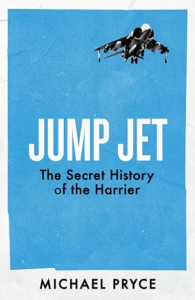 The story of how using computers in aircraft design stopped both Alan Turing and Ralph Hooper from fully realizing their dreams, and changed Britain’s post-war military aircraft industry, is told in my book, Jump Jet – The Secret History of the Harrier, out on August 27.
Michael Pryce is the author of Jump Jet – The Secret History of the Harrier. He is based in the U.K.