
“Massive 14-inch shells tore into the Frisco’s bridge, shredding metal and killing or severely wounding every officer but one: Bruce McCandless.”
By Bruce McCandless III
IN THE first months of 1942, the Japanese military seemed unstoppable. The Imperial Japanese Navy had crippled American forces in Hawaii and the Philippines and occupied Wake Island, Guam, and Saipan. Emperor Hirohito’s army, already in control of large swaths of China, now rolled over British holdings in Hong Kong and Singapore and forced the Dutch to surrender control of the East Indies, the fuel oil capital of Asia. Thousands of lives were lost.
The U.S. Navy had been responsible for safeguarding the nation’s interests in the Pacific. Now, as it tallied its losses—thousands of casualties, hundreds of airplanes, a dozen ships at the bottom of the sea or needing major repairs—Navy commander-in-chief Admiral Ernest King and his fleet commanders proceeded cautiously––leaving the Navy, insular, hierarchical, and now humiliated, to play a cat-and-mouse with the Empire’s metal juggernauts. The Navy looked weak and unprepared, and no one was happy about it.

On the heavy cruiser USS San Francisco, a young communications officer still smarted from the sight of Japanese dive bombers turning much of the Pacific Fleet into a smoking ruin on Dec. 7, 1941. Dispatched on the San Francisco with a task force just a few days later to relieve the Japanese assault on Wake Island, 30-year-old Lt. Commander Bruce McCandless had to endure the agony of constant delays ordered from on high as the American relief force dithered.
That summer, Admiral King decided that American backpedaling had to stop. The Japanese had seized an island in the Solomons chain called Guadalcanal without spilling a drop of blood. They were now building an airstrip there. From it, enemy planes would be able to harass the Allies. Alarmed, King ordered the nation’s first offensive action: Take Guadalcanal.

Called Operation Shoestring by American servicemen because it was put together hurriedly and somewhat haphazardly, the invasion of Guadalcanal by the 1st Marine Division on Aug. 7 was nevertheless a quick success. The Japanese military force occupied in constructing the airfield was stunned by the appearance of the Marines and melted into the jungle. But that initial success kicked up a hornet’s nest for Japanese forces. The several months of fighting that took place on and around Guadalcanal afterward can scarcely be matched for their ferocity and duration.
Almost immediately after the invasion, a Japanese convoy destroyed an American naval squadron on station to screen the Marines’ supply ships in the Battle of Savo Island. It was a stunning defeat for Allied naval forces: Four heavy cruisers lost and another severely damaged and over a thousand servicemen lost.

From there, the situation in the Solomons settled into a pattern: The U.S. owned the daytime hours, as Marine and Navy warplanes operating out of newly named Henderson Field patrolled the skies over Guadalcanal and its approaches. At night, Japanese convoys steamed down the island chain bringing reinforcements, arms, and ammunition for the Emperor’s men and then steaming on to bombard the U.S. Marines that held the airfield. Neither side had a clear advantage. For something to change, the Navy was going to have to stop the convoys.
The initial effort came with the Battle of Cape Esperance in October of 1942—a bloody but inconclusive engagement that, as with the Battle of the Coral Sea, produced significant losses on both sides. A month later, on the night of November 12 to 13, the Navy tried again. It quickly became what Admiral King described as “one of the most furious sea battles ever fought.”

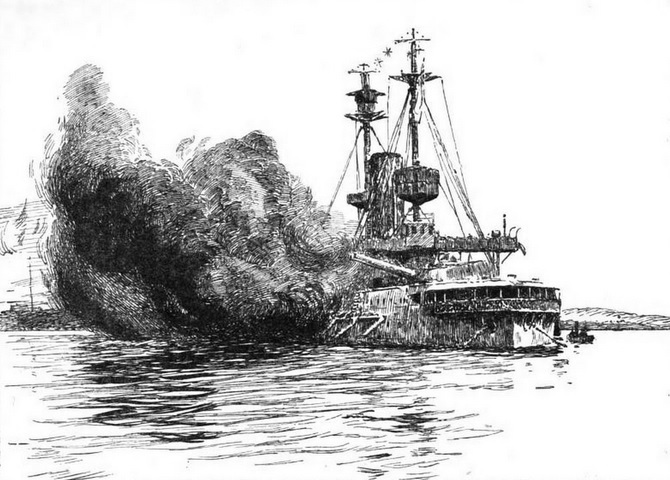
Rear Admiral Daniel J. Callaghan, flying his flag from the cruiser San Francisco, led a force of 13 ships into Savo Sound to challenge a much stronger Japanese group that included two battleships. It was a daring move, as the Japanese had so far inflicted serious casualties on every Allied surface force it had faced. At the white-hot center of this sprawling engagement, the San Francisco met the Japanese battleship Hiei. The two heavyweights traded broadsides at close range, to devastating effect. The Hiei’s massive 14-inch shells tore into the Frisco’s bridge, shredding metal and killing or severely wounding every officer but one: Bruce McCandless.
McCandless realized what was at stake. Admiral Callaghan had been directing his battle line, all thirteen ships, from the Frisco. Now that Callaghan, his staff, and the skipper and senior officers of the San Francisco were gone, the lieutenant commander realized that either he was in charge or no one was. There was no standing order or protocol for this eventuality, which was without precedent in American naval history.

Nevertheless, McCandless, working with an even younger helmsman named Harry Higdon, took command. He re-established communications, steered the Frisco, and directed fire against the enemy, including the Hiei’s sister ship, the battleship Kirishima. As soon as he could, he located the one senior officer on board, Lt. Cmdr. Herbert Schonland, to inform him of the situation. Schonland, who also won the Medal of Honor for his actions that night, had neither the time nor the inclination to return to the bridge and take command. He was battling tons of sea water below decks, working frantically to keep the Frisco afloat. It was up to McCandless to fight the ship and bring her home. This he did with aplomb, navigating by dead reckoning, firing on whatever targets presented themselves, and eventually returning the Frisco to the scattered American battle group.
The two sides broke off their engagement later that morning. As the Frisco limped back to Espiritu Santo for repairs, the battered Hiei foundered off Savo Island and later sank.

Two nights later, another American task force under Admiral Willis Lee, on board the battleship USS Washington, gutted the Kirishima, which meant that Japan had now lost two battleships in just three days. The emperor’s navy withdrew to lick its wounds, and the reinforcements they carried never made it to Guadalcanal. America’s Pacific forces began their slow, grinding offensive action, with the aim of crushing imperial Japan.
Three and a half more years of bitter fighting would be required before Imperial Japan finally offered up its unconditional surrender. But what happened off the coast of Guadalcanal in November of 1942 is sometimes called the turning point of the war. As a sailor named Edgar Jones put it, Guadalcanal was the “sharp knife point” of American attempts to turn back Japanese aggression. “The rest was the blade.” Admiral Bruce McCandless was one of the men who wielded that knife point and, in the midnight dark of the seas of Guadalcanal, drove it home.
 Bruce McCandless III is a best-selling author. His previous works include Wonders All Around, which recounts the first untethered spacewalk by his father Bruce McCandless II, and Star Bound with space journalist Emily Carney. His new book Iron and Fire: The Pacific War Story of Destroyer Captain Bruce McCandless — his grandfather — was released on October 13 by Naval Institute Press.