“The future first president’s famous boat ride was immortalized in an iconic 22-foot-wide painting entitled ‘Washington Crossing the Delaware’. Almost as interesting as the actual feat itself is the story behind the artwork.”
PERHAPS THE MOST celebrated moment of George Washington’s military career was his surprise attack on Trenton, New Jersey the day after Christmas in 1776. Yet for many, the centrepiece of this memorable victory isn’t the battle itself, but rather his crossing of the ice-choked Delaware River the night before.
The 10-hour nighttime operation saw 2,400 Continental troops traverse an 800-foot wide stretch of water between Upper Makefield, Pennsylvania and Titusville, New Jersey using a flotilla of rowboats and barges, all of which that were begged, borrowed or stolen from local residents. The entire undertaking was complicated by a winter storm.
Once safely on the opposite bank, Washington’s soaked and shivering army marched four hours in the pre-dawn gloom to surprise and overwhelm 1,500 Hessian mercenaries wintering in Trenton. The ensuing skirmish lasted only minutes. When it was over, Washington’s rag tag army had taken the town and netted nearly 1,000 prisoners. Although only a minor victory militarily, the triumph served to reinvigorate the flagging rebellion, which up until that point seemed all but doomed.
The future first president’s famous boat ride was later immortalized in an iconic 22-foot-wide painting entitled “Washington Crossing the Delaware”. And perhaps almost as interesting as the actual feat of arms itself is the story behind the artwork. Consider these facts:

1. It wasn’t painted by an American
The quintessentially American oil-on-canvas was actually painted by a immigrant. A German artist by the name of Emanuel Leutze completed it in 1851 – 75 years after the events he depicted had occurred. Leutze, who was born in Württemberg in 1816, lived in Philadelphia for a time and was enthralled by the history of North America. His other works included “The Battle of Monmouth” and the epic “Westward Ho.” Something of a revolutionary himself, Leutze hoped his dramatic rendition of a key moment in the American War of Independence might inspire Europe’s downtrodden workers to rise again in rebellion following the unrest of 1848. [1]


2. The rowboat contains some interesting characters
In addition to the artist’s portrayal of General Washington, the occupants of the rowboat represent a microcosm of 18th century America. They include a frontiersmen (at the bow), a Scot (second from the left facing aft), an African American (third from the left facing aft), a woman disguised as a man (foreground wearing a red shirt), two farmers (second and third from the right) and a native American (wearing buckskin and manning the tiller). Also in boat appear the future fifth president of the United States, James Monroe (clutching the flag) along with the Irish American general Edward Hand (the man seated fourth from the right wearing a bicorn hat). [2]


3. It’s rife with inaccuracies
The artist took a number of, shall we say, ‘creative liberties’ in his painting. For instance, the Stars and Stripes flag portrayed in the image didn’t actually exist at that time. [3] Up until 1777, the 13 colonies had adopted the Grand Union as their standard — 13 red and white stripes with a miniature Union Flag in the upper left. Also, the famous crossing took place in the dead of night and in foul weather — not at twilight under picturesque clearing skies. Some observers have also pointed out that a wooden boat of the size depicted in the painting would have probably sunk under the weight of so many passengers and that it’s unlikely anyone could have stood up in such a small craft without toppling it over. [4] In reality, Washington likely crossed the Delaware in a Durham boat, barge or bateau — not a small rowboat. Finally, the width of the Delaware at what is now known as Washington’s Crossing is much narrower than the picture illustrates. The artist based his painting on the Rhine, which is considerably wider.

4. America only received reproductions of the painting
Leutze completed the painting in 1850 and then composed a duplicate of it shortly afterwards. The original was damaged in a fire but later restored while the replica was put on display in New York. This second version was sold privately a number of times before becoming part of the Metropolitan Museum of Art’s permanent collection in 1897. The version of the painting that famously hangs in the White House’s West Wing is only a reproduction.

5. You’ll never believe how the original was lost
The original ‘Crossing’ remained in Germany after it was painted and went on display in the Kunsthalle Bremen art museum in 1851. There it remained for decades. Sadly, it was lost in an RAF bombing raid on Bremen in 1942. Many joked that its destruction was Britain’s final revenge for the American War of Independence. [5]

6. Many complain that the painting is obscene
In recent years, school board administrators throughout the U.S. have altered textbook depictions of the painting to remove a pocket watch fob that’s shown draped across Washington’s upper right thigh. Prudish educators and parents claim that the item resembled genitals and wanted the offending bits Photoshopped out.

7. It inspired hundreds of knock offs
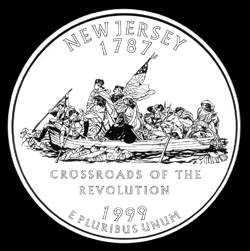
Predictably, the famous painting has inspired hundreds of parodies like this, or this, or even this. Likenesses have also graced everything from postage stamps to commemorative coins. It even inspired a 1936 poem in which each line is an anagram of the title: “Washington Crosses the Delaware”. A commemorative reenactment of the event is staged every Christmas Day at Washington’s Crossing State Park. This year’s will take place at 1 p.m. The episode itself was the subject of the award-winning 2000 A&E made for TV movie The Crossing, starring Jeff Daniels as Washington. The film, which was based on the 1971 Howard Fast novel of the same name, was filmed entirely on location in Canada. The full movie is available free online here.
(Originally Published on Dec. 16, 2013)